Puzzle Questions with Answers in Maths: 6 Solved Picture Puzzles and 1 Bonus Brain Challenge
Picture-based math puzzles are one of the best ways to improve number sense, pattern recognition, and logical thinking at the same time. In this article, you will find carefully explained puzzle questions with answers in maths, quick solving strategies, common mistakes to avoid, and helpful internal reading links for students who enjoy number puzzles, logical puzzles, and brain teasers.
What Are Math Puzzles?
Math puzzles are questions that ask you to find a hidden value, missing number, or correct final answer by observing a pattern. Unlike direct textbook sums, puzzle questions combine arithmetic with reasoning. You do not just calculate. You compare symbols, identify relationships, and then apply the right operation in the right order.
That is why these puzzles are popular among school students, aptitude learners, and readers who enjoy IQ test questions and quantitative aptitude practice.
Why Should You Practice Math Puzzles?
Solving puzzles regularly can sharpen the mind in a fun and practical way. They encourage active thinking and help learners become more careful with calculations, especially when multiplication, division, and hidden patterns appear together.
- They improve logical and analytical thinking.
- They strengthen pattern recognition.
- They help you use arithmetic more accurately.
- They build patience and observation skills.
- They are useful for aptitude tests, interviews, and classroom enrichment.
Puzzle Questions with Answers in Maths
Try each puzzle on your own before opening the explanation. This makes the activity more useful and more enjoyable.
Puzzle 1: Bird Logic Puzzle

Correct answer: 10
From the earlier equations, Peacock = 9, Sparrow = 3, and Parrot = 6.
Final expression: 9 + 2 × 3 ÷ 6
Apply multiplication and division first: 2 × 3 = 6, then 6 ÷ 6 = 1.
Now add: 9 + 1 = 10.
Puzzle 2: Fish Pattern Puzzle
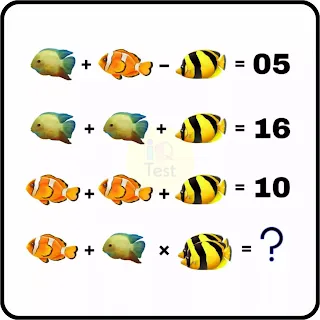
Correct answer: 51
Using the earlier lines, Green Fish = 6, Saffron Fish = 3, and Yellow Fish = 4.
Final expression: 3 + 6 × (4 + 4)
Bracket first: 4 + 4 = 8.
Then multiply: 6 × 8 = 48.
Finally add: 48 + 3 = 51.
Puzzle 3: Character Value Puzzle

Correct answer: 20
From the image pattern, Character B = 12, Character A = 7, and Character C = 15.
Final expression: 15 + 12 - 7
Add first: 15 + 12 = 27.
Now subtract: 27 - 7 = 20.
Puzzle 4: Mixed Concept Puzzle

Correct answer: 12.6
From the earlier rows, Singing Boy = 10, Skating Boy = 8, and Headphone = 5.
Final expression: 10 + (8 + 5) ÷ 5
Bracket first: 8 + 5 = 13.
Then divide: 13 ÷ 5 = 2.6.
Now add: 10 + 2.6 = 12.6.
Puzzle 5: Fruit Math Puzzle

Correct answer: 65
From the puzzle, Apple = 3, Orange = 4, and Mango = 17.
The final line becomes 6 × 8 + 17.
Multiply first: 6 × 8 = 48.
Add the last value: 48 + 17 = 65.
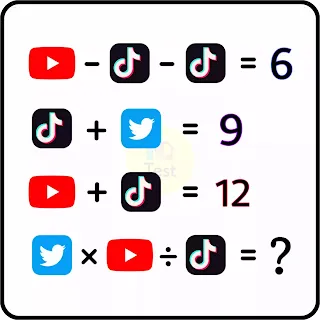
Puzzle 6: Bonus Social Icon Challenge
What You Learn from These Math Puzzles
These puzzles are entertaining, but they are also educational. They build habits that matter in mathematics, reasoning, and aptitude tests.
| Skill | How These Puzzles Help |
|---|---|
| Logical reasoning | You learn to identify relationships between symbols before calculating. |
| Pattern recognition | You become faster at spotting hidden rules and repeated structures. |
| Arithmetic accuracy | You practise addition, subtraction, multiplication, and division more carefully. |
| Order of operations | You learn why solving the right part first changes the final answer. |
| Concentration | You get better at noticing small differences between similar-looking objects. |
Smart Strategy to Solve Any Picture Math Puzzle
Most mistakes in picture puzzles happen because the reader rushes. A better method is to solve them slowly in a fixed order.
- Start with the easiest equation and find one symbol value first.
- Use that value to calculate the remaining symbols step by step.
- Check whether the final line changes the number of objects.
- Apply multiplication and division before addition and subtraction.
- Recheck the final expression before selecting an option.
Why Students and Exam Aspirants Like Math Puzzles
These puzzles turn practice into a game, which makes them easier to revisit. They are especially useful for students who want to become faster in numerical reasoning and for readers preparing for aptitude-style sections. If you enjoy this format, you may also like missing number puzzles with answers and quantitative aptitude questions.
Related Puzzle Articles on iQTestes
References
The explanations in this article follow standard arithmetic reasoning, especially pattern observation and order of operations. For readers who want to explore these concepts further, the following references are useful:
- Khan Academy: Order of Operations Review
- Khan Academy: Arithmetic Patterns and Problem Solving
- Britannica: Puzzle Definition and Overview
FAQs on Puzzle Questions with Answers in Maths
Are math puzzles good for brain development?
Yes. Regular puzzle practice can improve focus, observation, arithmetic confidence, and logical thinking.
Can beginners solve picture math puzzles?
Yes. Beginners should start with easier symbol-based puzzles and work slowly through each equation instead of trying to guess.
Why do students make mistakes in these puzzles?
Most errors happen because they skip a step, ignore a changed object in the final line, or forget the order of operations.
Are these puzzles useful for competitive exams?
They can be very useful for building reasoning speed, observation skills, and confidence in aptitude-style problem solving.
How often should I practise math puzzles?
Even 10 to 15 minutes a day can help improve pattern recognition and mental flexibility over time.
Final Thought
Math puzzles are fun, but their real value lies in how they train the brain to think carefully. When you practise enough of them, you become better at spotting relationships, staying patient, and solving problems with confidence.